A fireplace for every need
A cozy, warming fireplace and a Finnish home belong together. There are approximately 2.2 million operational fireplaces in Finland.
A fireplace is not just for heating. In many living rooms, it is the focal point of the room, where the family gathers to spend time together in the evenings. Fireplaces and various outdoor fire features are also becoming increasingly popular on patios and in yards for creating ambiance. A fireplace is therefore an important part of the interior design, even when there is no fire burning in it. That is why its appearance and style matter so much.
A fire in the fireplace creates warm memories that carry from childhood into adulthood. The firewood lit on the first fall evenings carries the scent of the past summer, and on cold winter days, the whole family gathers for a meal of game or root vegetable stew slow-cooked in the wood-fired oven.
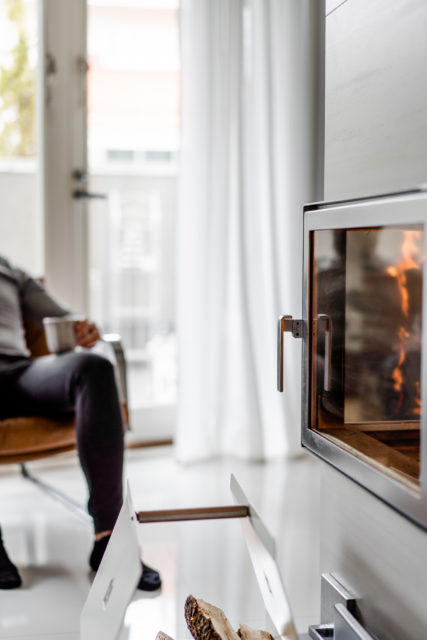
Part of the family
Many Finnish homes still heat with beloved fireplaces and stoves that have been in use for decades. Open fireplaces designed by renowned architects, beautiful tiled stoves, and beloved cylindrical stoves can be fully functional, even if they may no longer be very efficient as heating appliances.
It is always worth asking a professional about the possibility of restoring an old fireplace. However, if the fireplace is severely deteriorated, it may be wiser to dismantle it and replace it with a new fireplace that is significantly more efficient and environmentally friendly than the old one.
Many open fireplaces that are important to their owners are restored by installing a fireplace insert, which turns them into heat-retaining convection fireplaces. This makes it possible to retain much of the appearance of the old open fireplace. As a convection fireplace, it begins heating the space immediately after lighting, while the fireplace’s brick mass stores heat.
Old tiled stoves can be dismantled and reassembled. Likewise, old cylindrical stoves and brick fireplaces, especially beloved by Finns and originally built from red brick, can be restored. It is always advisable to request a condition assessment and a quote from several experts.

A fireplace for every taste and need
There are so many types of fireplaces on the market today for different purposes that anyone considering a new one should take the time to make their choice. Whether you are looking for a component for a hybrid heating system in a new passive house or a heat-retaining fireplace that provides long-lasting heat for an older home, there are plenty of options to choose from.
When exploring fireplaces, it is worth keeping your own needs, usage habits, and the fireplace’s location in mind. In older homes, the load-bearing capacity of the structure must be assessed and taken into account.
If the new fireplace is to be connected to an existing chimney, this must be considered when choosing the fireplace. A fireplace can also be installed in a property without an existing flue.
Important information when choosing a fireplace:
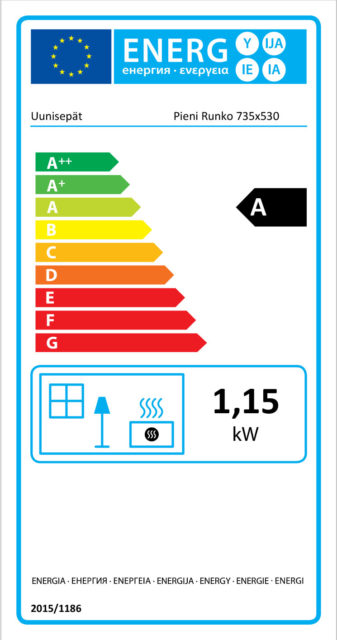
The energy label is familiar from electrical appliances. A fireplace’s energy label indicates how efficiently it can utilize the energy contained in wood – that is, transfer it as heat to the rooms. The energy class of a factory-made fireplace is indicated by an arrow graphic and a letter scale up to A++. The best Finnish fireplaces fall into classes A+ and A. Energy labels have been required since the beginning of 2018.
Fireplace energy labels are based on measurement results. For each new fireplace model, efficiency and carbon monoxide emissions, among other factors, are measured for type approval. The energy-label calculation formula takes more characteristics into account than CE marking, but not fine particulate emissions.
CE marking The EN 15250 standard governing the CE marking of the heat-retaining fireplaces mentioned above sets emission limits, among other requirements, for industrially manufactured fireplaces and ovens, within which they must operate. However, national regulations may require higher fireplace efficiency or stricter emission limits. This is the case, for example, in Finland and Germany.
The Ecodesign Directive will enter into force for fireplaces at the beginning of 2022. At that time, the energy efficiency of a heat-retaining fireplace must be at least 65%. For example, particulate matter emissions in flue gases may not exceed 40 mg per cubic meter.
The restrictions also apply to carbon monoxide, or CO, emissions and nitrogen oxides. Carbon monoxide emissions may not exceed 1,500 mg per cubic meter. Nitrogen oxides may not exceed 200 mg per cubic meter.
The requirements of the Ecodesign Directive do not pose a problem for Finnish manufacturers. The national implementation standard already in force requires the energy efficiency of a heat-retaining fireplace to be at least 70%.
Industrial manufacturers of fireplaces provide a Declaration of Performance (DoP) for their products in accordance with EU Regulation 305/2011. For heat-retaining fireplaces, for example, it is provided in accordance with EN 15250:2007. It specifies which research institutes may test fireplaces and which test results must be reported.
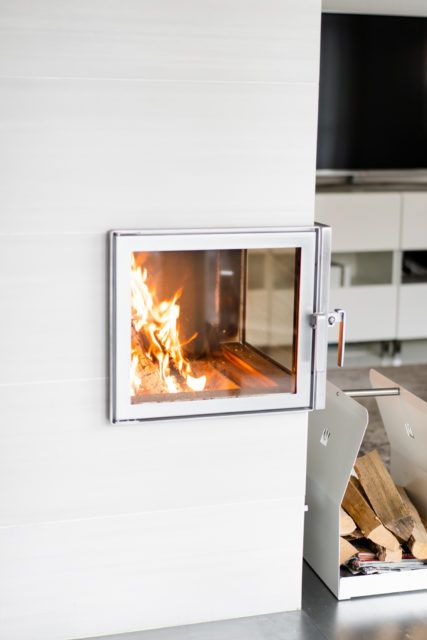
Efficiency indicates how effectively a fireplace can recover energy when burning wood – or pellets in a pellet fireplace. The measured efficiency is comparable, but the overall efficiency of heating, in other words, how much heat is actually obtained, also depends on heating practices and the cleanliness of the fireplace.
The heat yield of a heat-retaining fireplace, in kWh, indicates how much energy is recovered from wood in a single heating cycle, in other words, how much energy the fireplace stores in its structure.
The heat output in kilowatts of a fireplace, such as a wood stove. Heat output is important information for fireplaces that produce and release heat quickly, such as lightweight fireplaces and wood stoves. Their heat output is also higher than that of heat-retaining fireplaces, which operate on a different principle. A heat-retaining fireplace stores heat in its structure and slowly releases it into the room as radiant heat.
Semi-heat-retaining solutions naturally have both characteristics.
Heating area indicates the size of the area the fireplace is designed to heat. Walls and closed doors naturally prevent heat from transferring, so this refers to a continuous space, unless heat is transferred elsewhere in the house, for example from a convection fireplace through ductwork in an air heating system.
Heat release time is the period during which heat-retaining and semi-heat-retaining fireplaces release heat into the space after heating.
Of course, factors other than the fireplace’s heating properties must also be considered, such as:
Weight – The weight of the fireplace or of the fireplace and chimney matters both because of its heat-storage capacity and because a fireplace that is too heavy cannot be installed in the house. The load-bearing capacity of the structure at the intended installation location must therefore be known.
Clearance to combustible materials – A fireplace’s clearance indicates how close it can be installed to combustible materials, such as a wood-framed wall.
Chimney connection – Does the fireplace have a chimney connection from below or from above? Does a steel chimney need to be installed on top of it?
READ THESE TOO


