Firewood from your own forest or a local supplier
According to statistics from the Natural Resources Institute Finland, most of the firewood used in Finland, 6.5 million cubic meters, was made directly from roundwood sourced from forests. Of this, two-thirds was split firewood and one-sixth was full-length split logs.
The wood we burn most in our fireplaces is birch, about 2.7 million cubic meters. We burn 1.2–1.3 million cubic meters each of other hardwoods, pine, and spruce in our fireplaces.
There are 600,000 forest owners in Finland, so most Finns get their firewood from their own forests. Many farms and forest estates also operate businesses. Firewood sales are a traditional rural livelihood, where entrepreneurs earn income from many sources, so actual firewood sales are usually a sideline. Nevertheless, it is an important source of income for entrepreneurs – the industry’s annual revenue is approximately €20 million. Local firewood businesses are easy to find through online searches, and nationwide operators such as the Finnish Forest Centre’s Halkoliiteri.com and the power companies’ Mottinetti.fi connect people looking for firewood with suppliers. For example, Mottinetti has about one hundred active firewood sellers.
Both Halkoliiteri.com and Mottinetti.fi also provide comprehensive information on heating with a fireplace.
During the heating season, firewood is also sold at, for example, gas stations and hardware and agricultural supply stores.
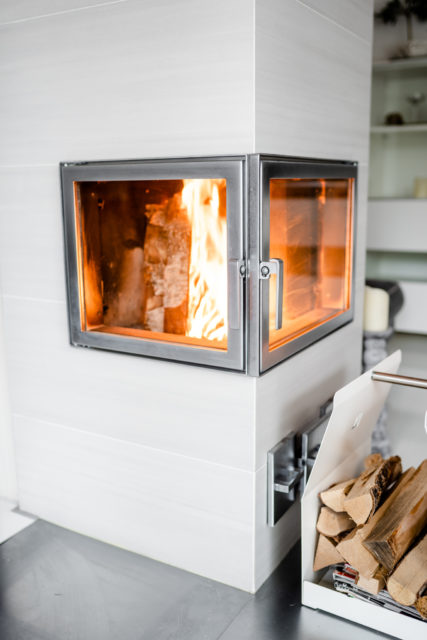
As roundwood, by volume, or packaged
If you are lucky, you can have your winter’s firewood delivered to your yard very affordably when a neighbor offers storm-felled birch and brings it straight to your yard on a tractor-drawn trailer, cut into lengths. Of course, firewood is also sold split into ready-to-use pieces, in packages holding enough for one fire, about 40 liters each. Firewood can be packaged in cardboard boxes, plastic wrap, or mesh bags.
You can buy firewood online both in bulk loads and packaged. When packaged, firewood is most commonly supplied in a bulk bag or pallet package of approximately 1 loose m3. Loose firewood usually arrives on a trailer pulled by a car or tractor, in which case you must stack the firewood in storage yourself.
Some suppliers offer a convenient rolling cart service. The firewood supplier provides the rolling carts used to store the firewood and replaces empty ones with full ones as agreed.
Making firewood
Making a year’s supply of firewood is, in many people’s view, an enjoyable pastime as well as useful everyday exercise.
If you do not have your own forest for making firewood, it is worth remembering that many small forest owners may welcome an offer to carry out thinning. You can ask for contact information from, for example, a local forest management association.
Late winter is the best time to fell trees intended for firewood, as the moisture content of deciduous trees in particular is at its highest in spring. After felling, the trees are limbed into logs and split for drying. It is a good idea to protect drying firewood from rain.
Naturally, not everyone enjoys working with firewood or is physically able to do it. A storm-felled birch dropped off in your yard by a neighbor has to be split, and a load brought by a firewood dealer has to be stacked under cover in the woodshed. Some member associations of the Finnish Detached House Association offer their members the Omakotitalkkari service, which provides a variety of property and home maintenance services for aging detached-home residents.
Firewood cutting and stacking work in the yard qualifies for the household tax credit.
What wood should I burn?
Many people who heat with wood have very strong opinions about the one and only species of wood suitable for their fireplace. For the older generation in particular, it is often birch. Birch and other dense wood species, such as beech, which is popular in Central Europe, gasify slowly and burn steadily. Spruce, which tends to spit sparks when burning, is generally not recommended for open fireplaces, but rather for fireplaces with doors and, for example, continuously heated sauna heaters.
Researchers have found that the effective heating value per weight of dry matter is nearly the same for different wood species, but birch is heavier than other species. Because of its high density, its heating value per volume is approximately 15% higher than that of coniferous wood.
However, the moisture content of firewood has a major effect not only on its heating value but also on how it burns in the fireplace. You should therefore always burn wood that is as dry as possible, as it has a better heating value and also burns more cleanly!
VTT, Eija Alakangas, Ari Erkkilä, Heikki Oravainen, “Efficient and Environmentally Friendly Wood Heating, Firewood Production and Use”
– More information about firewood is available from the Finnish Forest Centre’s Halkoliiteri service and the Bioenergia Ry website.
Store firewood properly
In the spring, yards around detached homes often feature such carefully stacked piles of firewood set out to dry that you would hardly believe anyone would want to take any of it for burning. In other yards, firewood has simply been tossed into a loose pile to dry. The appearance of a drying firewood pile is not important in itself, as long as the wood can dry efficiently.
The drying area should preferably be a sunny, open location where water cannot accumulate. Various types of frames can be used to keep firewood off the ground and arrange it in the desired shape. This also makes the pile easy to cover for protection from rain.
Wood must be dry when burned so that the energy it contains can be used as effectively as possible. Freshly cut wood has a moisture content of approx. 45–55%, while suitable firewood has a moisture content of 5–10%.
Dry wood ignites more easily than damp wood and burns and provides heat efficiently. One loose cubic meter of dry split birch firewood provides the same amount of heat as 1,000 liters of heating oil.
At the end of summer, nearly dry firewood should be moved under cover to continue drying in storage or in a woodshed. A good woodshed allows firewood to be stacked loosely so that it is ventilated. There should also be room to move around. The doorway should be large and the threshold low. Invest in lighting, as firewood is fetched during the dark season. If you are still planning a woodshed, place it close to your fireplace so that bringing in firewood is easy.
Safety first
Whether you have a woodshed or not, fire regulations must be taken into account when storing firewood (Rescue Act, section 9). According to fire regulations, easily ignited materials must not be stored in an attic, basement, underneath a building, or in its immediate vicinity.
Firewood must therefore not be stored stacked against the side of the house under the eaves!
According to fire regulations, no more than 0.5 m3 of firewood may be stored indoors unless it is kept in a separate fire-compartmented space. For example, cars and firewood may not be stored in a fire-compartmented garage at the same time.
Outdoor firewood storage is also subject to its own regulations. To avoid the need for fire-compartmenting structures, the storage building should be more than 8 meters away from other buildings. If the storage building is smaller than 20 m² and at least 4 meters from the property boundary, fire safety requirements do not apply to it. However, it is advisable to check the instructions and current practices of each municipality with the local building control authority.
Regulations on the fire safety of buildings can be found in parts E1–E9 of the Finnish Building Code. In addition, separate guidance on the fire safety of vehicle shelters can be found in section E4 of the Building Code.

Bring firewood indoors in good time
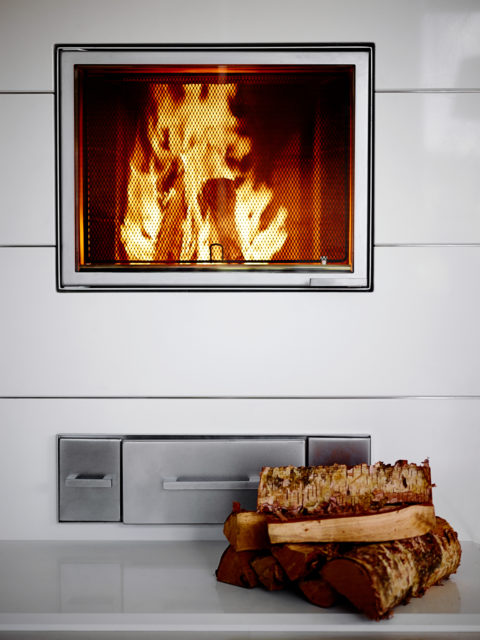
Bring firewood indoors to warm up a day before burning it. Most people want to store firewood neatly near the fireplace. Storing firewood indoors is rarely given enough thought. Some fireplaces naturally already include built-in firewood storage solutions, and the market offers various log carts as well as bags, baskets, and racks designed for carrying logs. Firewood piled in an untidy heap in a corner creates debris, gets carried to the wrong places, and can also cause accidents. It is also not advisable to carry large amounts of firewood indoors because firewood has been identified as one source of microbes in studies of indoor air in homes. Microbes include viruses, bacteria, fungi, algae, and protozoa. Studies have found, for example, Trichoderma and Penicillium fungi in firewood. Trichoderma fungus produces mycotoxins and can cause irritation symptoms in the eyes, throat, and nose, for example.
(Hillebrand, K. Kouki, J. 2006. Drying firewood – natural drying, artificial drying, and quality control. TSS. Publications of the Work Efficiency Institute 398. Helsinki 2006)
READ THESE TOO


